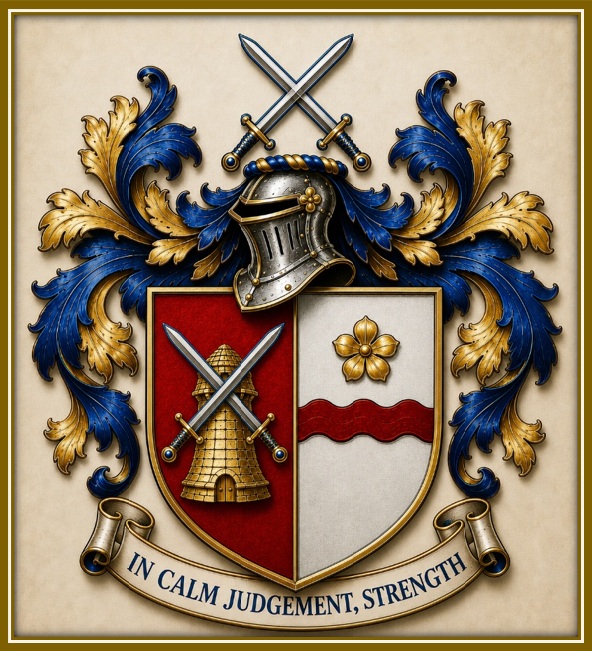
Windmill Family Office gives modern institutional form to inherited principles of practical capability, discretion, reputation, Stewardship and keeping one’s word.
The historical record contains four distinct Time-States. Each answers a different question, and none is presented as another.
THE PRESENT EVIDENTIAL POSITION
MORE THAN 1,000 YEARS
Bacon heritage
The family’s present research associates the Bacon heritage with East Anglia and with traditions of governance, law, learning, public responsibility and institutional memory.
The depth of that heritage describes a field of family history and cultural inheritance. It does not assert present title, privilege or legal entitlement.
APPROXIMATELY 400 YEARS
Windmill family origins
Family and documentary research traces the Windmill line across approximately four centuries.
The recurring inheritance is practical rather than titular: service, technical competence, steadiness under pressure, leadership, integrity and care for entrusted matters.
1891
Earliest presently identified Capital-stewardship Evidence
The year 1891 is the earliest presently identified expression of the family’s Capital-stewardship tradition.
It is an evidential index. It is not a date of corporate foundation, a mythic point of origin or proof that a formal family office or uninterrupted commercial enterprise then existed.
2026
Incorporation of Windmill Family Office Ltd
Windmill Family Office Ltd was incorporated in England and Wales in 2026 as the modern legal and institutional framework.
The company does not claim corporate existence before that date.
TWO COMPLEMENTARY INHERITANCES
The Bacon inheritance contributes knowledge, disciplined reasoning, governance, law, learning and institutional memory.
The Windmill inheritance contributes capability, service, technical competence, practical leadership and responsibility for entrusted matters.
The two families lived and worked in close geographical proximity for nearly four centuries before their histories joined through marriage in the twentieth century.
Their complementary traditions inform the character of the modern Office: knowledge applied through capability, and judgement expressed through responsible action.
In Calm Judgement, Strength.
A WORKING INHERITANCE
Family memory records earlier generations in Clerkenwell, Islington and Canonbury holding portable wealth, including gold and jewellery, and making private advances secured upon physical collateral. Hatton Garden formed part of the family’s jewellery-trading connections.
The record becomes more concrete around the family’s money-lending activity. Jonathan Windmill served in the police, although the particular force has not yet been established from the surviving family record. His wife continued the family’s money-lending activity and operated a London public house. The combination placed the household within dense local social and commercial networks in which reputation, information, creditworthiness and trust were closely connected.
Credit was not abstract finance; it was embedded in local knowledge, reputation and judgement. The value of the lending activity therefore lay not only in Capital available to lend, but in the quality of information surrounding the borrower, the relationship and the prospect of repayment.
The significance of that history is not a claim to a continuous financial enterprise. It lies in the disciplines associated with the Territory: judgement of character, protection of Value, discretion, Recoverability and the importance of keeping one’s word.
Capital appears within this history as responsibility rather than display.
REPUTATION AND THE WORD
Trust accumulates slowly and is impaired quickly.
A person’s word carries Value when others believe it is supported by judgement, integrity and the practical ability to perform. The modern Office retains that principle while replacing reliance upon personal Authority and unwritten understanding with records, defined roles, Evidential discipline and orderly Governance.
Personal Authority may create and control wealth; modern Governance ensures that ownership, responsibility and Stewardship survive the individual.
SERVICE AND CAPABILITY
The surviving family record shows a recurring pattern of military, public-safety and technical service across successive generations.
Jonathan Windmill served in the police; the specific force has not yet been established from the surviving family record.
Alfred Charles Windmill (1902–1990) briefly entered the Royal Navy while underage and was returned home when his age was discovered. He later served in the Home Guard during the Second World War. The episode is retained as family biography and is not counted as substantive Royal Navy service in the Office’s headline description of service across generations.
Ronald Alfred Windmill (1927–2019) and Leonard George Windmill served in the Royal Air Force. They also participated in an employer-sponsored industrial fire brigade associated with the engineering and electronics organisations in which they worked.
Steven Michael Windmill later served in the British Army.
The record is presented as family history rather than as a claim of institutional distinction. Documentary evidence is not uniform across every person or period: some service is supported directly by records, while other elements presently rest upon preserved family records and memory. The Office therefore treats this as a developing family record rather than an exhaustive service history.
The relevant inheritance is not the office or uniform itself. It is the standard attached to the responsibility: competence, preparation, reliability, disciplined action and care for those or that which has been entrusted.
1891 AND THE STEWARDSHIP TRADITION
The presently identified Stewardship tradition passes through family practice, memory, records and example before its systematic institutional codification.
Windmill Family Office Ltd gives that tradition a present legal and Governance framework. The company’s incorporation does not retrospectively convert family history into corporate history or make the company the successor to earlier private activity.
The modern Office distinguishes:
- family history;
- the development of a Stewardship tradition;
- current legal ownership;
- delegated responsibility;
- and the statutory identity of Windmill Family Office Ltd.
HISTORICAL DISCIPLINE
The story remains no stronger than the Evidence.
The family record distinguishes:
- documented lineage;
- established historical association;
- documentary and archival Evidence;
- preserved family memory;
- informed interpretation;
- working reconstruction;
- and matters still requiring confirmation.
Where the Evidence is complete, the record states the position directly. Where the historical field is coherent but the documentary chain remains incomplete, the language identifies the resulting uncertainty.
WHAT THIS HISTORY DOES NOT CLAIM
The public historical record makes no claim:
- to titles, arms, privileges or institutional usage rights arising from historical lineage;
- to certified descent where the documentary chain remains incomplete;
- that Windmill Family Office Ltd existed before 2026;
- that a formal family office existed in 1891;
- that the company owned, operated or succeeded to historic lending, jewellery trading or another earlier enterprise;
- or that family activity formed one uninterrupted commercial undertaking.
The history preserves Provenance, context and inherited responsibility. It does not manufacture status.
CONTROLLED HISTORICAL NOTE
Family Origins: A Short Historical Note
The public historical note provides a concise account of the documented record, preserved family memory, informed interpretation and evidential boundaries from which WFO draws institutional continuity.
Version 1.3 · Public historical note · Not a statement of legal entitlement
The more detailed family heritage volume remains a private source document. It supports cultural memory and Provenance but is not presented as a certified genealogical report or published as public Evidence.
RELATED RESOURCES
Family Origins explains the inheritance behind the institution while preserving the distinction between history, family practice, Stewardship Evidence and the modern company. The purpose is Continuity: to transmit the judgement, capability, obligations and lessons that accompany family Capital and reputation.