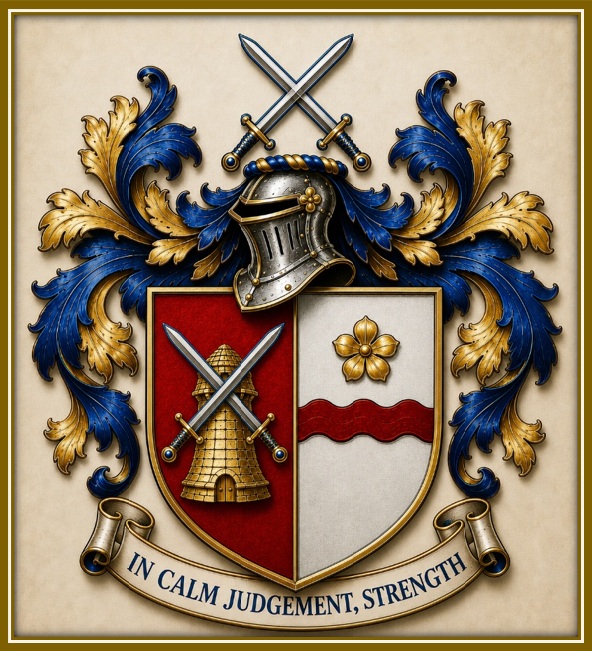
No family preserves its capability by accident.
The Windmill family’s history extends across four centuries. Within that longer history, its five most recent generations have lived and worked from London. Knowledge passed from person to person. Many important Decisions left little surviving record. And—as in most families—some of what mattered was simply lost because no institution yet existed to hold the thread.
The surviving record becomes clearer in 1891. It provides the earliest presently identified Evidence of a deliberate discipline: a Capital-stewardship tradition, evidenced rather than assumed. It did not announce itself. It continued quietly, generation to generation, long before the family gave it institutional form.
That discipline sat alongside another inherited standard. Across successive generations, members of the family served in the police, Home Guard, Royal Air Force and British Army, alongside industrial fire-brigade service associated with Britain’s developing engineering and electronics industries. The surviving family record distinguishes documented service from preserved family memory and identifies uncertainties where they remain. Stewardship and service ran together: the same willingness to accept named responsibility, whether the duty was to Capital, community or country.
What has changed is that responsibility is now named and organised. Leonard carries the family’s memory and the accumulated experience of what earlier generations built and protected. Steven holds present Principal responsibility for the family’s Purpose, Governance and major Decisions. Roger is preparing to carry that duty forward, building the investment capability the next generation will need.
In 2026, these three living generations gave the continuing duty its first formal institutional form: Windmill Family Office.
Through the Office, the family now coordinates its Capital, enterprise interests, knowledge, relationships, heritage and Succession as parts of one continuing responsibility.
The company is new. The duty is not.
Three routes through this site
This site provides three clear routes: an introduction to WFO’s origins, the WFO Purpose, people and institutional framework; practical information for professional engagement and controlled diligence; and access to WFO’s Research, publications and intellectual capital.
The principal menu, Public Index, Search and controlled glossary provide direct routes through the deeper material, allowing each reader to move quickly to the level of detail relevant to them.
UNDERSTAND WFO
Origins, WFO Purpose, people, Governance, Six Capitals and long-term Stewardship.
Enter this route →02WORK WITH OR DILIGENCE WFO
Professional engagement, banking and credit diligence, information requirements and controlled access to Evidence.
Enter this route →03RESEARCH AND INTELLECTUAL CAPITAL
Research programmes, publications, institutional thinking and the complete public archive.
Enter this route →Explore the institutional framework
INSTITUTIONAL IDENTITY
Windmill Family Office Ltd provides the principal modern legal and administrative framework for the Office.
The company is incorporated in the United Kingdom in 2026. Its legal age remains distinct from the family history and Stewardship tradition to which it gives institutional form.
WFO exists principally to serve the family’s own Purpose and proprietary interests. It may seek finance or Capital for WFO, family, asset or enterprise purposes and may make selected capability available through properly governed external appointments and engagements.
PURPOSE
Preserving family capability—not merely family assets
WFO helps successive generations to:
- make sound Decisions;
- identify, Evidence and steward family Capital;
- maintain reliable records and institutional memory;
- protect reputation and relationships;
- coordinate professional and institutional resources;
- preserve Decision rationale;
- prepare deliberately for changes in responsibility;
- and sustain the capability to act as circumstances change.
FAMILY CAPITAL
Six interdependent dimensions of Value
WFO recognises that family Capital extends beyond the conventional balance sheet.
The Six Capitals provide a structured framework through which the Office identifies, understands and stewards different forms of Value:
FINANCIAL CAPITAL
Accumulated economic capability capable of deployment in pursuit of Purpose.
CULTURAL CAPITAL
The inheritance of identity, meaning and reputation available to guide and support future generations.
RELATIONAL CAPITAL
Stored trust and reciprocal capability residing in continuing relationships.
INTELLECTUAL CAPITAL
Identifiable products of thought and creativity capable of retention, protection, application, transfer or development.
INSTITUTIONAL CAPITAL
Accumulated legitimacy, access and capability embedded in recognised institutional participation.
KNOWLEDGE CAPITAL
Information, experience and expertise converted into the capability to interpret, judge and act.
The dimensions are distinct but interdependent. A single asset, relationship, right or capability can carry Value across more than one Capital.
GOVERNED STEWARDSHIP
Authority is defined, Decisions are evidenced and material matters are tested against Purpose, ownership, Risk, affordability, timing, Recoverability and consequence.
Stewardship preserves, develops, deploys, transforms and transmits Capital in support of Purpose across generations.
WFO protects family Capital against avoidable permanent impairment while preserving the capacity to adapt, restructure, Realise or release Capital where continued retention no longer serves its Purpose.
CONTINUITY ACROSS GENERATIONS
Honorary Chairman
Leonard represents the senior living generation, family history, institutional memory and the continuing Stewardship tradition.
Steven Michael Windmill TD MBA BA(Hons)
Principal and Director
Steven leads Purpose, strategy, Governance, Capital Stewardship, major Decisions and institutional relationships.
Director of Investment & Stewardship · Principal-Designate
Chair, Investment Committee
Roger provides investment and professional coordination, integration, Knowledge Management and deliberate preparation for Succession.
WFO’s leadership combines present executive responsibility, delegated professional capability and deliberate preparation for Continuity across generations.
CULTURE, KNOWLEDGE AND ENGAGEMENT
Family history, archives, values, traditions and inherited standards form part of the Capital available to guide future generations.
WFO maintains a developing body of Research, publications and commentary across Governance, Capital, institutional behaviour, technology, public policy, leadership and long-term Stewardship.
Public Service & Charitable Interests
Public service, civic participation and charitable support reflect personal conviction, inherited standards and the wider responsibilities accompanying Stewardship.
WFO provides an institutional context for appropriate board, advisory, speaking, Research and professional participation while preserving the distinction between the Office and the separate professional capacities of family members.
INSTITUTIONAL RELATIONSHIPS
WFO maintains orderly relationships with professional advisers, private banks, institutions and other legitimate counterparties.
Public information establishes institutional identity, Governance and context. Non-public information is provided through controlled diligence according to the verified counterparty, legitimate Purpose and stage of engagement.
WFO communicates wealth and Capital through appropriate Evidence, Provenance and professional assessment rather than unsupported public valuation claims.
STANDING AND DISCRETION
WFO treats reputation as accumulated Cultural and Relational Capital.
Introductions, recommendations and commitments are made deliberately because each draws upon trust accumulated through conduct, judgement and performance. Reliability depends upon both the intention and the practical capacity to perform.
The Office governs disclosure according to Authority, relevance, Purpose and legitimate need.
HERITAGE AND EVIDENCE
The present family record distinguishes:
- more than 1,000 years of Bacon heritage;
- approximately four centuries of Windmill family history;
- an identifiable Capital-stewardship tradition for which the earliest presently identified Evidence dates from 1891;
- and the incorporation of Windmill Family Office Ltd in 2026.
These dates describe different things. WFO distinguishes documented history, family tradition, interpretation and uncertainty rather than presenting the age of the company as the age of the family or its Stewardship practice.
INSTITUTIONAL BOUNDARY
WFO exists principally to serve the family’s own Purpose and proprietary interests. It may seek finance or Capital for WFO, family, asset or enterprise purposes and may make selected capability available through properly governed external appointments and engagements.
The Office does not manage third-party Capital, accept deposits, offer investment or credit products, provide regulated financial services to the public or represent itself as a bank, lender, credit-rating agency or regulated investment firm.
Public material provides institutional context. It does not constitute an offer, solicitation, transaction commitment, valuation, guarantee, financial promotion or substitute for independent professional diligence.