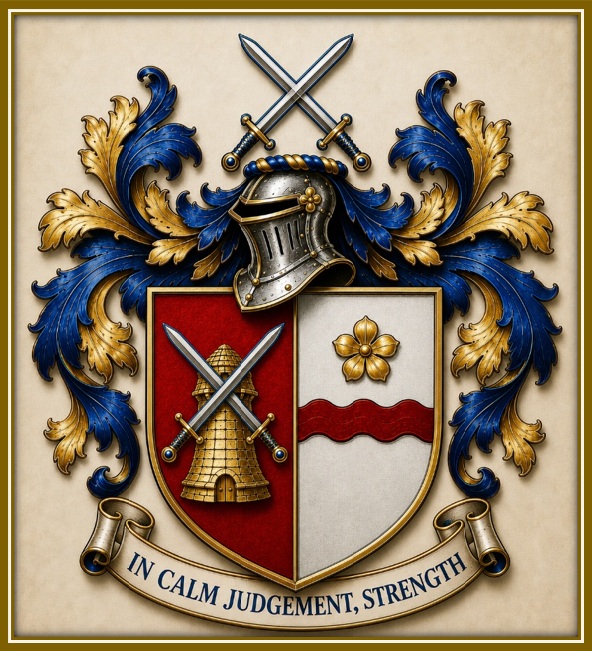
The development of institutional doctrine does not occur independently of the people responsible for exercising judgement within the institution.
This section preserves selected current writing by Steven Windmill, Principal, where that work is relevant to the intellectual and decision environment of the Windmill Family Office.
Authorship remains individual. Inclusion records relevance; it does not retrospectively convert individual writing into Institutional Research or WFO policy.
Where an idea subsequently becomes incorporated into formal WFO doctrine, Governance or policy, the applicable institutional document should be treated as the authoritative source for the WFO position.
Selected current writing
Published Thinking
Individual authorship · informative institutional context · not WFO policy unless separately adopted.
You Do Not Fight the Territory. You Update the Map.
Argues that institutions cannot fight changing reality; they must maintain and update the maps by which consequential decisions are made.
Author: Steven Windmill · Institutional status: Informative; not WFO policy unless separately adopted.
Read publication →The Board’s Blind Spot in Value Preservation
Examines the board-level blind spots through which otherwise viable organisations fail to preserve recoverable value.
Author: Steven Windmill · Institutional status: Informative; not WFO policy unless separately adopted.
Read publication →The First Question I Ask at the Board Table
Translates governance doctrine into a practical question designed to reveal the real constraint at the board table.
Author: Steven Windmill · Institutional status: Informative; not WFO policy unless separately adopted.
Read publication →Fixing the Code: The Governance Oversight I Refused to Ignore
A case-based account of governance conduct when formal oversight, evidence and institutional responsibility diverged.
Author: Steven Windmill · Institutional status: Informative; not WFO policy unless separately adopted.
Read publication →Mission Command in Corporate Governance: Aligning Board Purpose with Business Performance
Applies military mission-command doctrine to board purpose, delegated authority, accountability and organisational performance.
Author: Steven Windmill · Institutional status: Informative; not WFO policy unless separately adopted.
Read publication →🧭 Leadership at Altitude
Explores leadership at higher levels of abstraction, where judgement, intent and institutional consequence matter more than direct control.
Author: Steven Windmill · Institutional status: Informative; not WFO policy unless separately adopted.
Read publication →From Tiny Rowland to Today: The Discipline of R³
Traces the intellectual and practical origins of Recoverable Value (R³) and the discipline required to identify value others overlook.
Author: Steven Windmill · Institutional status: Informative; not WFO policy unless separately adopted.
Read publication →The Blocked Exit: Why R³ Matters More Than Liquidity
Explains why blocked exits are often symptoms of deeper recoverability failures rather than simple shortages of liquidity.
Author: Steven Windmill · Institutional status: Informative; not WFO policy unless separately adopted.
Read publication →Beyond the Economic Model — Why AI Now Does What Only a Nexialist Once Could
Uses the idea of the nexialist—the integrator across disciplines—to explain how Artificial Intelligence can connect knowledge at unprecedented scale.
Author: Steven Windmill · Institutional status: Informative; not WFO policy unless separately adopted.
Read publication →Implementing AI: Living with the Uncertainty of a Fast-Evolving Tool as a NED
Considers the responsibility of non-executive directors when adopting a fast-evolving technology whose uncertainties cannot be eliminated in advance.
Author: Steven Windmill · Institutional status: Informative; not WFO policy unless separately adopted.
Read publication →PROVENANCE
Publication class: Published Thinking. Capacity: individual author / Principal, Windmill Family Office. Original publication dates and external locations remain part of each work's historical record.
Where a work later becomes Institutional Research through formal WFO adoption, the adoption record should preserve its original author and date while separately identifying the WFO adoption date and institutional status.