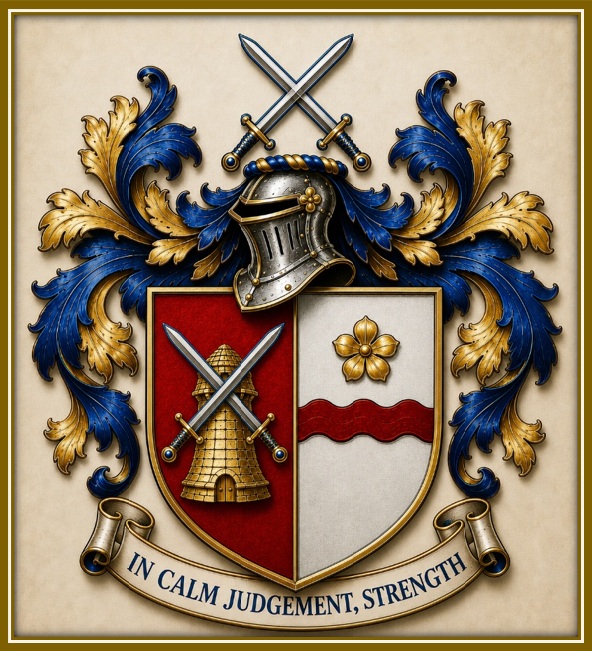
The Family Council provides WFO with a structured intergenerational forum for family Governance, Continuity, Succession, Stewardship and Family Learning.
Its role is to ensure that significant family responsibilities are considered across generations and across the Six Capitals, while preserving clear distinctions between family Governance, executive management and legal or corporate Authority.
It provides a disciplined forum through which family members can understand the Capital, responsibilities and institutional context they inherit and contribute intelligently to their future Stewardship.
The existence of Governance should be visible. Its sensitive mechanics need not be.
MEMBERSHIP
Membership of the Family Council is drawn from descendants of Alfred Charles Windmill who currently hold, or previously held, the Windmill family name by descent or marriage.
The Council presently distinguishes between:
- Council Members — voting participants;
- Family Participants — non-voting family participants who attend, contribute, question and express views.
The Council comprises eight voting Council Members, together with a broadly similar number of Family Participants.
Participation in the Family Council does not of itself create ownership, corporate office, statutory Authority or entitlement to family assets.
Those rights and responsibilities arise separately through the relevant legal, corporate, trust, contractual or other governing arrangements.
CHAIRING, FAMILY RELATIONSHIPS AND DECISION QUALITY
Chair: Steven Windmill, Principal — since 2019.
The role is not ceremonial. The Principal determines which matters require Council consideration, frames the decision to be made, ensures that relevant evidence and professional advice are available, and keeps the distinction between family influence, delegated responsibility and legal or corporate Authority clear.
Material investment and stewardship proposals are considered across the Six Capitals. A proposal that appears financially attractive may also affect family relationships, reputation, cultural inheritance, institutional standing, accumulated knowledge or the capability available to future generations. The Council must therefore examine more than price and prospective return. It must also consider Purpose, ownership, Risk, liquidity, reversibility, recoverability, time horizon and the consequences of success or failure across the wider family institution.
Family Governance contains difficulties that a conventional corporate board can sometimes avoid. Participants do not enter the room only as office-holders. They bring personal history, differing needs, generational perspectives, expectations of fairness and continuing relationships that must survive the immediate Decision.
The Principal's responsibility is to keep the substantive question visible, ensure that competing views are heard and prevent personal friction from obscuring Evidence, Authority or institutional Purpose.
The Honorary Chairman works in close association with the Principal. Drawing upon the perspective and standing of the senior living generation, he helps smooth tensions, preserve participation and distinguish disagreement over a particular proposal from damage to the enduring family relationship. His role supports cohesion and continuity; it does not displace the Principal's responsibility for chairing the Council or create executive or corporate Authority.
Where a Council conclusion requires action by Windmill Family Office Ltd, the Investment Committee, an asset owner, trustee, director or another legally authorised person, that Authority must be exercised separately through the appropriate governing structure.
INTERGENERATIONAL PARTICIPATION
Children and younger family members are encouraged to participate before acquiring voting responsibility.
Family Participants can:
- receive and study appropriate material;
- attend Council discussions;
- listen to professional or family presentations;
- ask questions;
- contribute observations and opinions;
- and develop familiarity with family Capital and Governance.
Voting eligibility begins at age 25.
The objective is not to defer learning until Authority is transferred.
It is to create sufficient understanding before responsibility arrives.
Succession should transfer the capability to judge, not merely inherited conclusions.
FAMILY LEARNING
Family Learning is a continuing Council responsibility rather than a separate educational event.
It includes understanding:
- the Six Capitals;
- family history and Provenance;
- Governance and Authority;
- investment and Stewardship;
- Risk and Capital Defence;
- professional relationships;
- institutional behaviour;
- family responsibilities;
- and the intellectual frameworks through which WFO interprets complex Decisions.
Family Learning also preserves the distinction between receiving information and developing judgement.
A successor who knows what previous generations decided but not why they decided it inherits a weaker form of Knowledge Capital.
STANDING AGENDA
The Family Council maintains a standing agenda sufficiently broad to ensure that family Stewardship is not reduced to Financial Capital alone.
Governance & Succession
Authority, Governance arrangements, Continuity, future responsibilities and preparation of succeeding generations.
Material financial position, investment, liquidity, Private Banking, Capital allocation and related Stewardship matters.
Intellectual property, authored and creative work, methodologies, research and other Intellectual Capital.
Intellectual property and relevant IAS 38 considerations remain a standing agenda matter rather than being addressed only when a transaction occurs.
Cultural & Relational Capital
Family history, reputation, relationships, traditions, archives, cultural assets and their Stewardship.
Institutional relationships
Material institutional participation, standing, professional relationships and Institutional Capital.
Technology & Cyber Risk
Digital capability, information resilience, access, backup, recovery and relevant cyber Risk.
The Council considers the governing discipline and assurance position rather than publishing sensitive technical implementation.
Personal Risk
Material key-person, accident, health, insurance and other personal Risks capable of affecting family Continuity or Capital.
Property Risk
Material risks affecting family, residential, commercial or other relevant property interests.
Personal Safety
Appropriate personal-safety and protective arrangements where circumstances require.
Implementation, providers, locations and operational details remain protected.
Family Learning
Continuing development of the knowledge, judgement and institutional understanding required by present and future generations.
Other Business
Material issues falling outside the standing agenda remain capable of consideration where relevant to family Purpose or Stewardship.
SIX CAPITALS
The Family Council considers family interests through the Six Capitals:
- Financial;
- Cultural;
- Relational;
- Intellectual;
- Institutional;
- Knowledge.
The categories are analytical rather than exclusive.
A single Council issue can therefore affect several forms of Capital simultaneously.
For example, a family property can contain Financial and Cultural Capital; an institutional appointment can create Institutional, Relational and Knowledge Capital; and a family archive can carry Cultural, Intellectual and Knowledge Value.
The Council is therefore concerned not only with what the family owns, but with the wider capability available to it and the responsibilities associated with that capability.
CAPITAL DEFENCE
Capital Defence forms part of the Council's continuing Stewardship responsibility.
The Council considers whether family Capital is being:
- preserved where preservation remains appropriate;
- developed where greater Value can be created;
- protected against avoidable permanent impairment;
- restructured where present arrangements no longer serve Purpose;
- or transmitted with sufficient context for future Stewardship.
Capital Defence does not require preservation of every historic form.
Continuity preserves what remains valuable; it does not require the preservation of every historic Map.
INVESTMENT GOVERNANCE
The Family Council sits within WFO's graduated investment-Governance architecture.
Material investment Decisions are subject to oversight through appointed officers, the Investment Committee and, according to their significance, the Family Council acting through a quorum.
The Council does not replace the Investment Committee or the delegated Authority of WFO officers.
Its role is to provide the higher level of family Governance appropriate to Decisions whose scale, duration, Capital consequences or institutional significance warrant broader oversight.
Private financial thresholds and other sensitive internal mechanics are not published.
PROFESSIONAL INPUT
The Family Council can receive input from professional advisers and specialist functions where their expertise is relevant to the Council's Decision environment.
These include, according to the matter concerned:
- investment professionals;
- bankers;
- lawyers;
- accountants;
- tax advisers;
- risk and compliance specialists;
- technology and cyber specialists;
- cultural or historical specialists;
- and other professional advisers.
Specialist participation does not transfer the Council's family-Governance responsibility to the adviser.
Professional Maps remain professionally owned and are considered within the wider Decision environment.
ANNUAL STEWARDSHIP REVIEW
The Windmill Family Office undertakes an Annual Stewardship Review, normally completed in time to inform the annual meeting of the Family Council.
The review is circulated to family members and other invited attendees at least four weeks before the meeting, allowing sufficient time for consideration, questions and matters requiring Decision to be identified before the Council assembles.
The review provides a structured examination of the Office's stewardship, Governance, resilience and current institutional position. Topics typically considered include:
- assets, liabilities, legal ownership and their relationship to the Six Capitals;
- delegated Authorities, access arrangements and the continuing allocation of operational and administrative responsibility;
- liquidity, existing commitments and contingent exposures;
- insurance and other relevant protections;
- concentrations, dependencies and single points of failure;
- succession, continuity and arrangements for Principal unavailability;
- implementation of previous Family Council Decisions and forthcoming transactions or Capital events;
- family capability, professional development and succession readiness;
- structural resilience, including what may fail first, how long existing arrangements could continue, what depends upon a particular person, institution, jurisdiction or asset, and the available replacement or recovery route;
- the Authority required to respond to identified Risks or changes, including consequential effects across the other Capitals; and
- matters requiring legal, financial, banking, insurance or other professional review.
The review is intended to ensure that Governance arrangements remain effective in practice rather than merely correct in form.
The Family Council has not presently agreed that the Annual Stewardship Review should routinely be made public. The Office may publish selected reviews, extracts or public summaries in future where the Council considers publication appropriate.
Accordingly, this website records the existence, Purpose and cadence of the review without disclosing its private contents.
MEETINGS
Routine meetings rotate through:
London → Paris → Rome → New York
This provides continuity while avoiding the assumption that family Governance belongs permanently to a single location.
Extraordinary meetings are held elsewhere where circumstances require.
Meeting location does not alter the Authority, ownership or legal jurisdiction of any underlying company, trust, asset or transaction.
RECORDS AND TIME-BINDING
Material Council discussions, Decisions and relevant supporting material are preserved through appropriate records and Knowledge Management.
The objective is not merely administrative record-keeping.
Records preserve:
- what was known;
- what Evidence was available;
- what assumptions were made;
- what alternatives were considered;
- what Decision was reached;
- and what was subsequently learned.
This supports Time-Binding, Knowledge Capital and Succession.
A Decision without its reasoning is a weakened form of institutional memory.
CONTINUITY AND RESILIENCE
The Council considers family Continuity across more than ownership or inheritance.
Relevant disciplines include:
- Authority;
- Knowledge transfer;
- professional relationships;
- digital resilience;
- property resilience;
- personal Risk;
- insurance;
- security;
- and Succession.
Public disclosure establishes that these matters are governed.
Detailed dependencies, providers, routes, security arrangements and technical implementation remain protected.
WFO publishes enough to establish Continuity is actively governed, but not enough to make Continuity easier to disrupt.
RELATIONSHIP WITH WINDMILL FAMILY OFFICE LTD
The Family Council forms part of the wider family Governance architecture.
It does not displace the statutory responsibilities of directors of Windmill Family Office Ltd, nor the Authority created by the company's Articles, applicable law or another governing legal instrument.
Where corporate action is required, the relevant corporate Authority must be exercised separately.
Family Governance informs and supports Decision-making; it does not manufacture corporate power.
PURPOSE ACROSS GENERATIONS
The Family Council exists ultimately to help ensure that successors inherit more than assets.
The intended inheritance includes:
- understanding;
- judgement;
- Knowledge;
- institutional memory;
- relationships;
- cultural context;
- professional capability;
- and the Governance structures needed to steward Capital responsibly.
Good Stewardship leaves successors not merely with what was inherited, but with the Capital, capability, knowledge, relationships, Optionality and institutional capacity required to steward effectively themselves.
RELATED RESOURCES
SELECTED FAMILY COUNCIL RECORD, 2019–2026
This public record identifies material points in the Council's recent institutional history. It does not reproduce private discussion, personal information or the sensitive mechanics of family governance.
2019 — Succession of principal responsibility
Steven Windmill assumed principal responsibility for the family's stewardship arrangements on 14 January 2019. The Family Council continued as the forum for significant matters of family stewardship and continuity.
2020–2021 — COVID-19 period
No substantive formal Family Council meetings were held during the principal COVID-19 disruption. Family communication and continuity were maintained through a series of Zoom and WhatsApp video calls. No material Family Council decisions are recorded for this period.
2022 — Record unavailable
No surviving record of a substantive Family Council meeting or decision has been identified for 2022.
2023 — Continuity following family loss
Against a year that included the deaths of Peggy Windmill (1940–2023) and Robert Hale (1989–2023), the Council considered matters of family continuity, record, responsibility and succession. The importance of preserving family history and institutional memory alongside financial assets became increasingly explicit.
2024 — Formalisation proposed
The Principal brought forward a proposal to formalise the family's existing family-office arrangements through a registered corporate family office. The Council initiated consideration of incorporation, governance, ownership and continuity arrangements.
2025 — Formalisation agreed in principle
The Council agreed in principle to formalise the existing family-office arrangements, subject to detailed disclosure and development of the proposed governance and corporate structure.
2026 — Corporate structure approved and implemented
Following further development and family consideration, approval was obtained to proceed with formal incorporation. Windmill Family Office Ltd was established, with governance, decision rights and investment oversight formalised.