
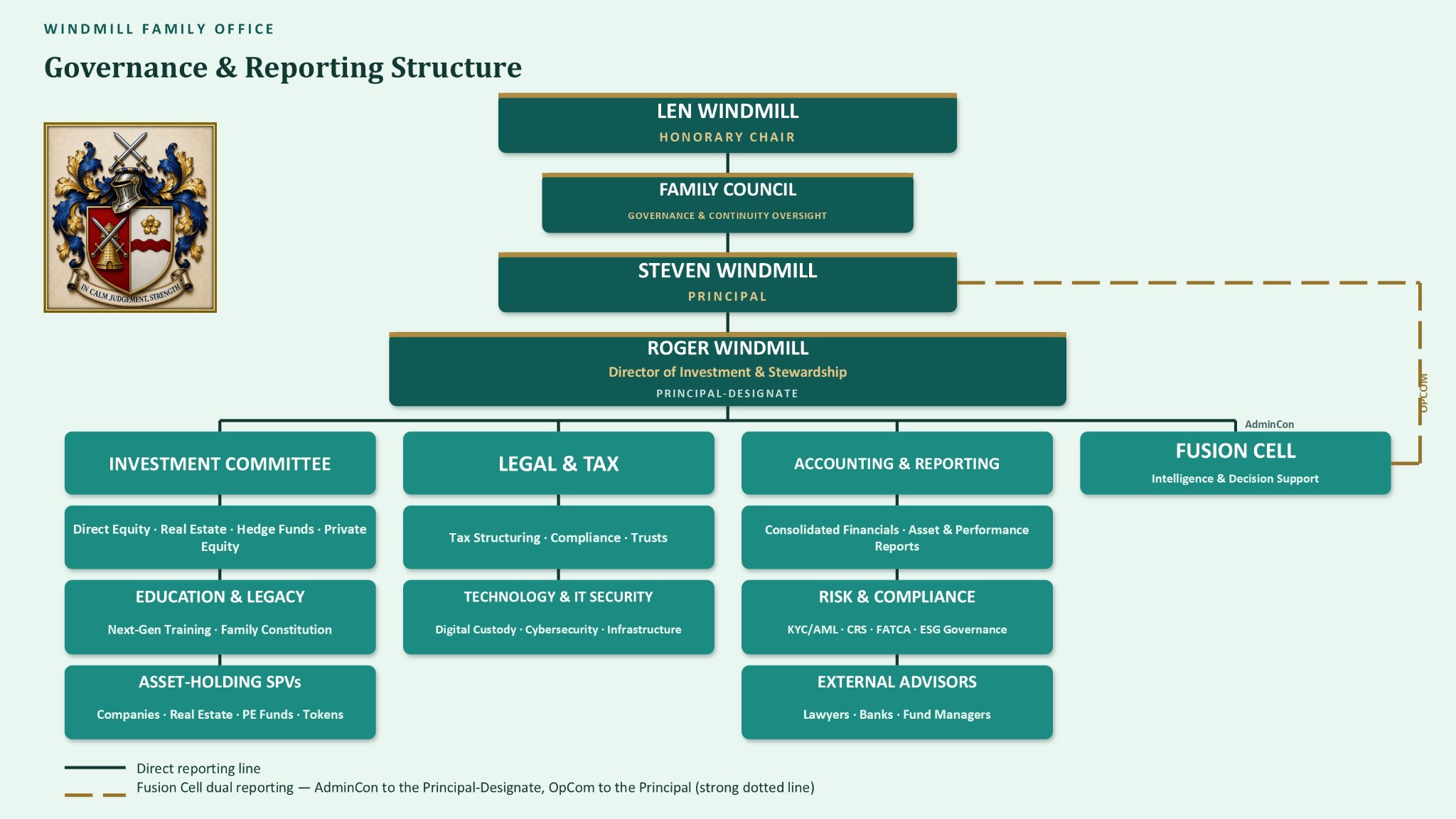
WFO’s Governance and Stewardship Structure shows how family Governance, executive responsibility, investment Stewardship, specialist professional capability, Decision support, Capital Defence and Succession operate together.
It is a practical Map of the Office’s present working relationships. It is not a corporate ownership chart, a statutory organisation chart or a statement that every relationship has the same legal form.
The diagram is read together with the explanation and legend below. Where law, Articles of Association, a contract, trust instrument, security document or another governing instrument applies, that instrument remains controlling according to its terms.
A NOTE ON WFO TERMINOLOGY
Three generations of military service have left an identifiable mark upon the family’s vocabulary and ways of organising responsibility.
WFO adapts the terms OPCOM, OPCON and ADCON because they provide concise answers to three practical questions:
- who manages the people or capability concerned;
- who defines the Purpose, priorities and required work;
- and who administers the resulting engagement.
Their use does not imply that WFO operates as a military organisation or exercises military-style command over employees, advisers or counterparties.
OPCOM — INTERNAL MANAGEMENT RESPONSIBILITY
Within WFO, OPCOM describes the control and management of people and capability employed directly by the Office.
The Principal retains OpCom. The Director of Investment & Stewardship / Principal-Designate exercises AdminCon across the Office, including routine administration, coordination, workflow, records and continuity, subject to the Authorities reserved to the Principal, Board and Family Council.
Where capability is supplied by an external professional organisation, that organisation retains the corresponding responsibility for its own people, including employment, line management, professional supervision and personnel administration.
OPCON — PURPOSE, PRIORITIES AND TASKING
OPCON describes WFO’s direction of the Purpose, priorities, scope, tasking and required outputs of externally supplied capability for the duration and purposes of the relevant engagement.
It establishes what WFO requires from the relationship. It does not transfer employment, line management, professional command or statutory responsibility from the external adviser or its parent organisation.
ADCON — ADMINISTRATION AND CONTRACT COORDINATION
ADCON describes the WFO-side administration required to support the engagement.
Depending upon the circumstances, this includes:
- suitable workspace and office technology;
- travel, subsistence or accommodation arrangements;
- timetable and dependency coordination;
- receipt and retention of agreed deliverables;
- contract administration;
- checking, authorisation and payment coordination of invoices;
- record retention;
- and Knowledge Management.
ADCON supports effective delivery. It does not control the professional conclusions reached by an adviser or interrupt the direct provision of substantive analytical outputs to the Fusion Cell.
The terms therefore clarify responsibility without changing the legal, contractual or professional relationship between WFO and the external party.
HOW TO READ THE STRUCTURE
The structure begins with the family institution.
The Honorary Chairman represents continuity with the senior living generation and the family’s Stewardship tradition. The Family Council provides the principal intergenerational forum for Governance, Continuity, Succession and Family Learning. Family Learning & Legacy and Succession & Continuity support the transfer of Knowledge, capability and responsibility across generations.
The Principal holds overall responsibility for WFO Purpose, strategy, executive direction and the family Capital committed through the Office.
The Director of Investment & Stewardship exercises delegated investment and Stewardship responsibilities, chairs the Investment Committee and coordinates the WFO-side administration of external professional capability.
The Investment Committee supports disciplined Capital allocation and Stewardship. Private Banking provides banking, liquidity, lending, planning, investment and associated financial capability according to the requirements of WFO and the relevant relationship.
Specialist functions provide Legal & Tax, Accounting & Reporting, Risk & Compliance, Technology & Cyber Resilience and other external professional capability. Asset and Enterprise Structures represent the companies, property, funds, holdings and other arrangements through which relevant family interests are held or conducted.
The Fusion Cell integrates substantive specialist outputs into the wider Decision environment. Capital Defence operates across the structure and across all Six Capitals.
FAMILY GOVERNANCE AND LEGAL AUTHORITY
WFO is a wider family institution whose activities are conducted through companies, trusts, contractual arrangements, professional relationships and other appropriate structures.
Windmill Family Office Ltd provides a principal corporate expression of the Office. It does not exhaust the wider family institution.
Family standing, corporate office, delegated Authority, professional responsibility, Influence and legal capacity to bind a person or entity remain distinct.
Family Governance informs the exercise of judgement and Stewardship. It does not manufacture statutory or contractual Authority where none otherwise exists.
PRACTICAL WORKING RELATIONSHIP
The Principal exercises internal management responsibility — OPCOM — over people and capability employed directly by WFO.
Where an external professional organisation supplies capability, WFO exercises OPCON over the Purpose, priorities, scope, tasking and required outputs of the engagement. The external organisation retains employment, personnel administration, line management and professional responsibility for its own people.
The Director of Investment & Stewardship provides WFO-side ADCON: the administrative and contractual coordination required to support the engagement.
The practical relationship is therefore:
Principal / WFO OPCON → Director of Investment & Stewardship ADCON → parent organisation OPCOM over its own people.
The relationship does not prevent direct professional communication or substantive reporting. It distinguishes management, tasking, administration and professional responsibility so that each remains visible.
SPECIALIST RESPONSIBILITY
Each specialist function retains responsibility for the integrity of its own Professional Map, advice and professional obligations.
A lawyer, accountant, banker, investment professional, tax adviser, engineer or security specialist can examine the same Territory and reach different but professionally valid conclusions because each discipline asks different questions and applies different abstractions.
WFO does not require those conclusions to become artificially identical. It requires their assumptions, limits, dependencies and material interfaces to remain clear.
ANALYTICAL REPORTING AND THE FUSION CELL
Substantive analytical outputs pass directly from the relevant specialist function into the Fusion Cell. The Fusion Cell can seek clarification directly from that function.
ADCON does not filter, alter or supervise professional conclusions before they reach the Fusion Cell.
The Fusion Cell provides WFO with a cross-domain analytical and Decision-support capability. Specialist functions retain ownership of their respective Professional Maps, while their substantive outputs are provided to the Fusion Cell for integration, clarification and comparison within the wider Decision environment.
The Fusion Cell does not replace specialist judgement or manufacture consensus. Its purpose is to identify material differences, preserve Provenance and unresolved uncertainty, and ensure that interfaces between professional analyses are understood before Decisions are taken.
Its output is an integrated Decision picture. It preserves the integrity of the contributing Professional Maps while identifying material interdependencies, differences and consequences across the Six Capitals and Capital Defence.
DECISION AND ESCALATION
The structure supports appropriate delegation without separating Authority from Accountability.
Material Decisions are considered according to Purpose, Value, Risk, duration, reversibility, Capital consequences, dependencies, institutional significance and effect upon future Optionality.
Oversight increases with consequence. Relevant matters pass through appointed officers, the Investment Committee and, where appropriate, the Family Council acting through a quorum. Private thresholds and sensitive internal mechanics are not published.
Execution responsibility does not create wider Decision Authority. A person implementing a Decision does not acquire Authority to approve, guarantee or assume an obligation beyond the delegation actually given.
PRIVATE BANKING
Private Banking sits within the structure because banking relationships can affect liquidity, leverage, security, investment capability, Recoverability and Continuity across more than one form of Capital.
The Principal defines the Purpose, priorities and acceptable parameters of the relationship. The Director of Investment & Stewardship coordinates the WFO-side administration and relevant interfaces. The bank retains responsibility for its own people, professional processes, regulatory obligations and credit Decisions.
Private Banking remains a professional counterparty relationship. Its inclusion in the structure does not imply that a bank is part of WFO, that WFO directs the bank’s regulated judgement or that a facility exists unless separately agreed and documented.
CAPITAL DEFENCE
Capital Defence operates across the structure rather than within a single function.
It connects Governance, Evidence, ownership, Value, liquidity, Recoverability, Risk, Opportunity Cost, Optionality, Continuity and Succession across Financial, Cultural, Relational, Intellectual, Institutional and Knowledge Capital.
The structure therefore makes responsibility and material interfaces visible without suggesting that every Risk is owned by one person or function.
ASSURANCE WITHOUT VULNERABILITY
WFO makes its Governance architecture sufficiently visible to support legitimate understanding, professional engagement and proportionate diligence.
It does not publish private financial thresholds, security arrangements, access controls, personal vulnerabilities or other sensitive operating detail merely to demonstrate that controls exist.
The existence of Governance should be visible. Its sensitive mechanics need not be.
DIAGRAM LEGEND
- Family Governance and Continuity — family standing, intergenerational participation, learning and Succession.
- Executive Authority and delegated responsibility — direction and Accountability within WFO.
- OPCOM / Internal Management Responsibility — management of directly employed people and capability; for external capability, retained by the parent organisation.
- OPCON / Purpose, Priorities and Tasking — WFO direction of the Purpose, scope, priorities, tasking and required outputs of externally supplied capability.
- ADCON / Administration and Contract Coordination — WFO-side administrative and contractual support for the engagement.
- Specialist analytical reporting — direct provision of substantive professional outputs to the Fusion Cell, shown independently from ADCON.
- Fusion and Decision support — integration, clarification and comparison of Professional Maps without displacement of specialist responsibility.
- Capital Defence — a cross-cutting discipline operating across the structure and all Six Capitals.
This diagram illustrates the Governance, Stewardship and working structure of WFO. It is not a corporate ownership or statutory organisation chart.