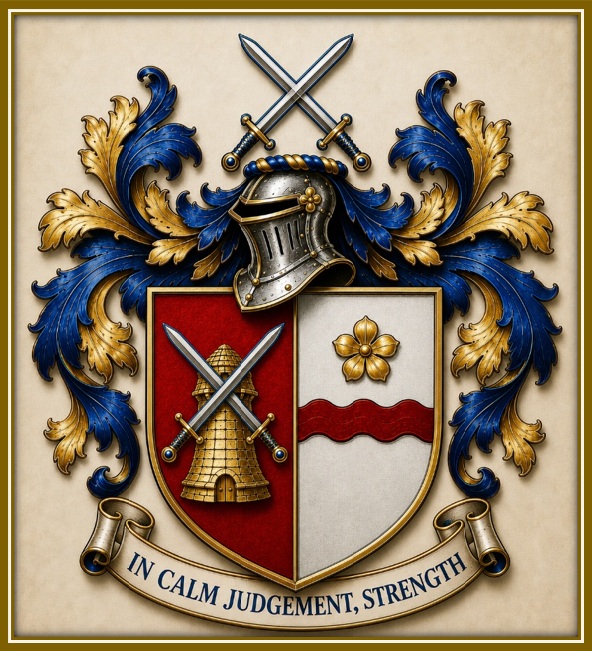
Three generations hold distinct but connected responsibilities within WFO: preserving institutional memory, exercising responsibility in the present and preparing deliberately for Continuity.
WFO’s leadership combines present executive responsibility, delegated professional capability and deliberate preparation for continuity across generations.
LEADERSHIP ACROSS GENERATIONS
WFO gives durable institutional form to family Stewardship practices evidenced from 1891.
Its leadership structure distinguishes:
- family standing and institutional memory;
- present executive responsibility;
- corporate office;
- delegated Authority;
- professional responsibility;
- and preparation for Succession.
Titles describe responsibilities within the WFO framework. They do not create statutory, contractual or delegated Authority beyond the Authority actually held.
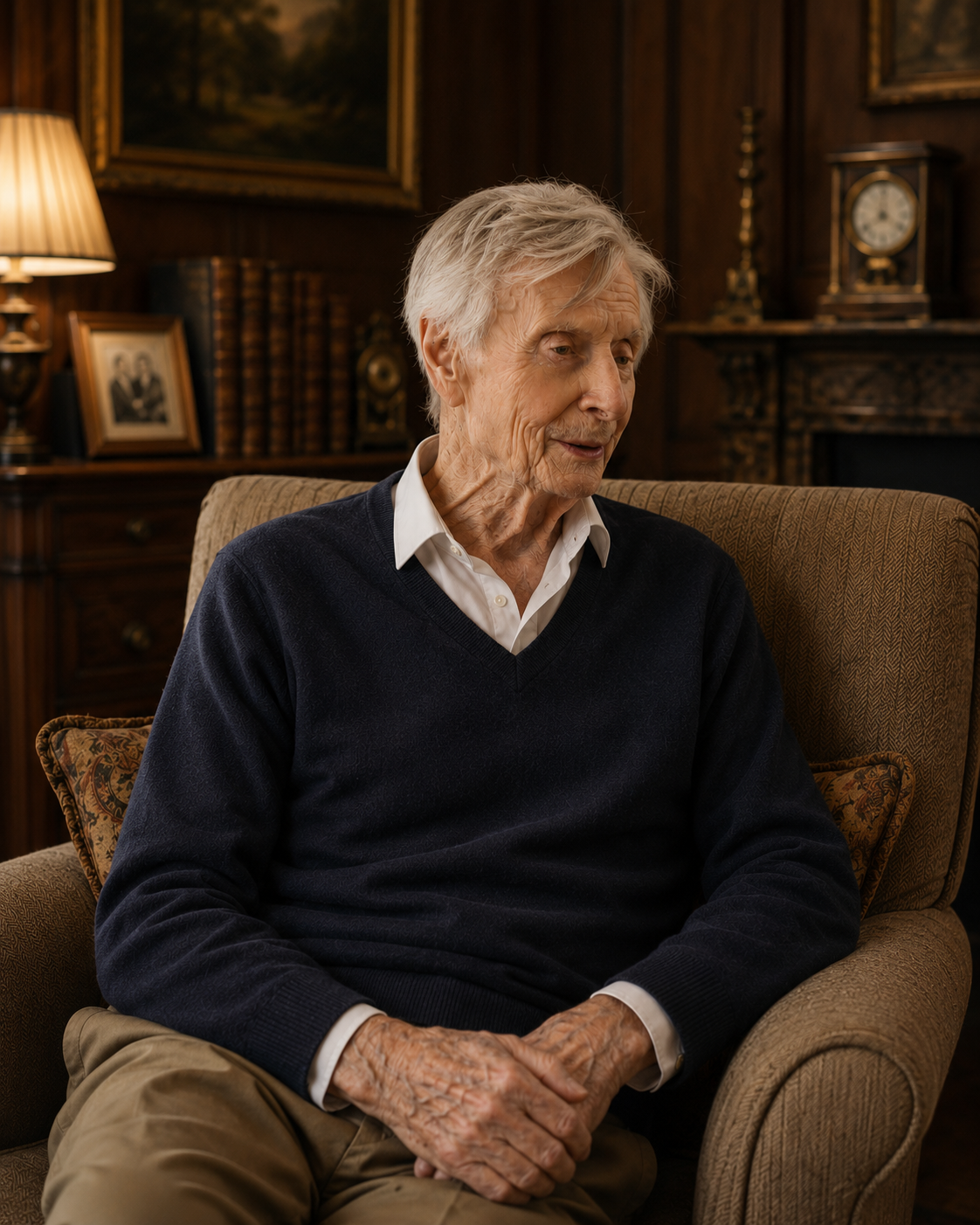
Continuity and institutional memory
Leonard George Windmill
Honorary Chairman
Born in 1929, Leonard George Windmill is the senior living member of the Windmill family and serves as Honorary Chairman of Windmill Family Office.
His early service included work with Royal Air Force radar. He later worked with early Royal Navy electronic systems and, alongside his principal employment, also participated in an employer-sponsored industrial fire brigade associated with the engineering and electronics organisations in which he worked.
That combination of technical work, public service and practical responsibility gives context to his present role. Leonard represents family history, institutional memory and the continuing stewardship tradition rather than current executive management.
He provides continuity between the experience and standards of earlier generations and the responsibilities carried by the present and next generations. His recollections have also contributed directly to the Office’s reconstruction and preservation of family history, including the principles taught by his brother Ronald Alfred Windmill.
Living independently into his late nineties, Leonard remains an active source of family memory, perspective and counsel. His reflections, experience and encouragement have helped shape the Office’s approach to Family Learning, Governance, Succession and continuity across generations.
As Honorary Chairman, Leonard’s role is familial and institutional. It is distinct from present executive management, delegated decision authority and statutory corporate office.
“A family must know upon what it stands if it is to stand for anything at all.”
Leonard “Len” George Windmill — “Closing Reflection”, The Windmill Family Origins
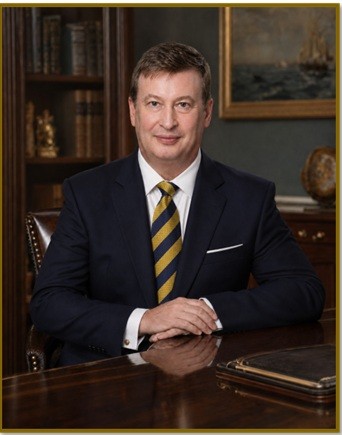
Present stewardship and institutional responsibility
Steven Michael Windmill TD MBA BA(Hons)
Principal and Director, Windmill Family Office Ltd
Steven holds overall responsibility for WFO Purpose, strategic direction, Governance and the family Capital committed through the Office.
As Principal, he leads:
- Purpose and strategy;
- Governance and institutional development;
- Stewardship of Capital;
- major Decisions and institutional commitments;
- professional and institutional relationships;
- Capital Defence;
- Succession and Continuity;
- and the Fusion Cell’s cross-domain Decision environment.
The title Principal identifies institution-wide responsibility and Accountability. It does not collapse ownership, corporate office, delegated Authority or legal capacity into a personal title.
Steven’s approach draws upon executive, board, investment, transformation, public-sector and military experience spanning finance, operations, law, Governance, Risk, strategy, institutional behaviour and complex Decision environments.
His Decision practice is also informed by formal philosophical study, including undergraduate work supervised by Sir Roger Scruton, and by the study and application of General Semantics since adolescence.
These influences encourage WFO to understand competing positions on their own terms, distinguish a Map from the Territory it describes, and test Decisions against Evidence, consequences and credible alternatives rather than narrative preference.
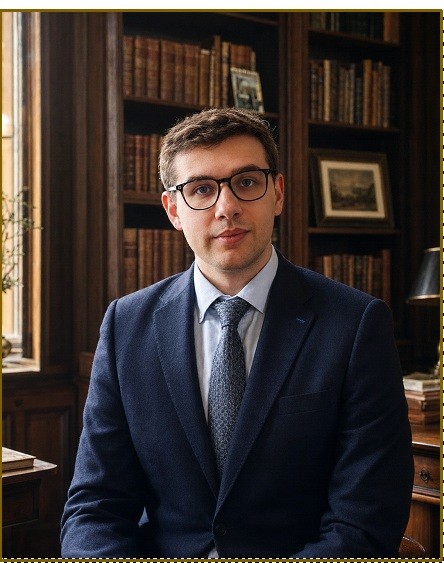
Next-generation stewardship
Roger Stefan Windmill
Director of Investment & Stewardship · Principal-Designate
Chair, Investment Committee
Roger exercises delegated responsibility for investment and Stewardship matters within the Authority granted to him.
He chairs the Investment Committee, which presently comprises Steven and Roger, and brings the relevant perspective of a professional career in wealth management. His responsibilities include:
- investment assessment and Capital allocation;
- portfolio and Stewardship oversight;
- professional coordination;
- WFO-side administration and contract coordination;
- integration and Knowledge Management;
- maintenance of relevant investment and institutional records;
- and preparation for the orderly transfer of Knowledge, capability and responsibility.
Roger holds a First-Class BSc (Hons) in Business Studies.
Director of Investment & Stewardship is a functional Office title. It does not of itself create statutory directorship or Authority beyond the Authority separately held or delegated.
Principal-Designate records deliberate preparation for Succession. It does not create automatic present Authority or predetermine a future legal appointment.
PREVIOUS STEWARDSHIP
Previous Honorary Chairmen are retained here as part of the Office’s institutional and family record. Their inclusion records stewardship and continuity; it does not imply that Windmill Family Office Ltd existed during their earlier lives or activities.
Technical capability, learning and family standards
Ronald Alfred Windmill
Former Honorary Chairman · In Memoriam
1927–2019
Ronald Alfred Windmill was born in 1927 and represented a generation in which technical competence, public service, intellectual curiosity and practical self-reliance were closely connected.
He served in the Royal Air Force and spent his working career in radar and associated electronic systems. His work progressed from ground-to-air radar to air-to-ground radar and into a succession of related technologies and applications, including the development and use of colour radar imagery. His career therefore ran alongside a formative period in British radar and electronics development, from predominantly military applications into increasingly sophisticated imaging and derivative systems.
Alongside his brother Leonard, Ronald also participated in an employer-sponsored industrial fire brigade associated with the engineering and electronics organisations in which they worked.
In 1953 he married Patricia “Pat” Bacon, joining the Windmill and Bacon family lines. They had three children: Steven, Caron and Debbie.
Ronald was an exceptionally persistent reader. He would read virtually any book available to him in English and regarded newspapers largely as a substitute when no book was to hand. Reading was not treated as a pastime separate from life, but as a continuing means of understanding the world.
He retained the same practical energy physically. He remained exceptionally fit and active into later life; shortly before his death he was still climbing trees and carrying out demanding work around his home. That combination of intellectual curiosity, physical capability and reluctance to regard age as a reason for inactivity was characteristic of him.
Within the family, Ronald was remembered particularly through standards of conduct rather than formal doctrine: do the work, keep one’s word, retain humility and look after the family quietly over time. Those principles were reconstructed in 2026 by Leonard George Windmill and Steven Michael Windmill as A Father’s Code, explicitly as remembered family teaching rather than as a recovered historical document.
“Give your word sparingly; once given, keep it.”
Ronald Alfred Windmill — A Father’s Code / A Knight’s Oath
Ronald served as Honorary Chairman within the family stewardship arrangements preceding the formal incorporation of Windmill Family Office Ltd. His contribution is retained within the Office as part of the continuity between inherited family practice and its present institutional form.
Enterprise, labour, ownership and relational credibility
Alfred Charles Windmill
Former Honorary Chairman · In Memoriam
1902–1990
Alfred Charles Windmill was one of the principal entrepreneurial figures in the twentieth-century development of the family.
He entered the glass trade at the age of thirteen in 1915. By 1919, while still a teenager, he was supervising men returning to civilian employment after service in the First World War. By 1924 he was running a glass and mirror-making business in Clerkenwell, London.
His early commercial progress was accompanied by an equally early lesson in institutional access. In 1923, when he first attempted to open a bank account, he was initially turned away. The position changed when bank staff realised that the two businessmen accompanying him were already respected customers and were prepared to act as his references. Family memory preserves the additional detail that the two Rolls-Royces outside the bank belonged to them. The episode became an early example of the importance of reputation, sponsorship and trusted relationships in gaining access to institutions.
Alfred later became involved in organising workers across the London trade. He did not treat workforce interests and commercial performance as inherently opposed. Instead, he demonstrated to employers that better treatment of staff could improve productivity. The same two businessmen who had earlier vouched for him at the bank later helped fund the wider union initiative after he had persuaded them of the commercial value of that approach.
Over time, Alfred accumulated interests beyond the glass trade. He came to own a number of corner shops in North London, including Enfield and Wood Green, and in Hertfordshire, including Kings Langley. His career therefore combined operating management, labour organisation, banking relationships, entrepreneurship and direct ownership.
As a young man he also briefly entered the Royal Navy, before his mother secured his return when it was discovered that he was underage.
Alfred’s significance within the family lies less in any single enterprise than in the breadth of his activity and the way he moved between apparently different worlds: employer and workforce, banking and entrepreneurship, operating businesses and asset ownership. He appears to have understood early that commercial performance depended not only upon Capital, but upon people, reputation, relationships and institutional confidence.
That combination of practical judgement, enterprise and relational credibility became an important part of the family’s later stewardship tradition.
He subsequently served as Honorary Chairman within the family stewardship arrangements that preceded the modern Windmill Family Office.
DIRECTION, DELEGATION AND COORDINATION
The Principal retains internal management responsibility for people and capability employed directly by WFO.
Where an external professional organisation supplies capability, WFO defines the Purpose, priorities, scope, tasking and required outputs of the engagement. The external organisation retains employment, line-management, personnel-administration and professional responsibility for its own people.
The Director of Investment & Stewardship coordinates the WFO-side administration and contractual support required for the engagement.
These relationships correspond to WFO’s use of OPCOM, OPCON and ADCON. Their fuller meaning, including the family origin of the terminology, is explained in the Governance & Stewardship Structure.
PROFESSIONAL RESPONSIBILITY AND REPORTING
Delegation does not transfer professional responsibility from an adviser or specialist organisation to WFO.
Each professional function remains responsible for the integrity of its own advice, analysis, professional obligations and Professional Map.
Substantive specialist outputs pass directly into the Fusion Cell for integration, clarification and comparison. Administrative coordination does not filter, alter or supervise the professional conclusions provided.
THE INVESTMENT COMMITTEE
The Investment Committee supports disciplined Capital allocation and Stewardship.
Roger chairs the Committee in recognition of his wealth-management experience and delegated investment responsibilities. Steven participates as Principal and retains the wider institutional Accountability attached to WFO Purpose, Capital Stewardship and major Decisions.
The Committee’s role, Decision rights and escalation arrangements operate within defined delegated Authority. Private financial thresholds and sensitive internal mechanics are not published.
SUCCESSION AND CONTINUITY
WFO treats Succession as the transfer of capability, Knowledge, Authority and responsibility rather than ownership alone.
Preparation therefore takes place before a transfer becomes necessary. It includes participation in current Decisions, understanding the Evidence and reasoning supporting them, maintaining institutional records, developing professional relationships and increasing responsibility in a controlled manner.
Principal-Designate expresses that deliberate preparation. It does not displace the Principal, create automatic Authority or remove the need for the legal, corporate and Governance actions required at the relevant time.
RELATED RESOURCES
WFO’s leadership combines present executive responsibility, delegated professional capability and deliberate preparation for continuity across generations.